6 Best Dropshipping Courses in 2026: Pros & Cons, Pricing, Student Reviews, and Business Model Alternatives
Updated On
Dropshipping is an online business model where you sell products without owning or storing any inventory yourself. All you need to do is:
- Pick a niche or group of people to sell to (for example, pet owners, gym goers, or new parents).
- Find a dropshipping supplier that ships products directly to your customers.
- Set up an online store, list the products, and drive traffic using ads, SEO, or social media.
- Place the order with your supplier when someone buys, and they ship the product straight to the customer.
It sounds easy enough, but from my experience selling shark onesies, it requires a lot of knowledge and skills, especially when it comes to picking the right niche and marketing it to the crowd. So if you’re set on starting a dropshipping business, it’s a good idea to take a course first.
However, there are so many scam courses out there. You’ll be paying thousands of dollars without getting any value. This is why I’ve created my own list of the best dropshipping courses. I go over their pros and cons, pricing, student reviews, what they teach, and who the creators are. I also answer some FAQs about the business model. Finally, I compare it to the business I switched to after quitting my own dropshipping store, called local lead generation.
1. The Accelerator by Nick Dahlberg
Pros | Cons |
|---|---|
✔️ The Accelerator teaches you how to build a real, branded store instead of random 1-product or general stores. | ❌ The Accelerator sits in the middle of a funnel that leads into more expensive 1-on-1 mentorship. |
✔️ It includes hands-on support and systems like “pass/fail” reviews, group coaching calls, store templates, etc… | ❌ The other coaches aren’t clearly explained, which can be a red flag if you want to fully verify who’s teaching you. |
✔️ Nick Dahlberg has a huge online following and a good online reputation. | ❌ It focuses on TikTok and Reels, which are tough for beginners to get views and attention. |
Price: | The Accelerator costs $997. | ||
|---|---|---|---|
Refund policy: | The Accelerator has a 72-hour refund window. | ||
Reputation: | Nick Dahlberg has 149.2K Tiktok followers, 49.2K Instagram followers, and 6.45K YouTube subscribers. | ||
The Accelerator is Nick Dahlberg’s branded dropshipping online course. What makes it stand out is that it teaches how to build a legit-looking ecommerce brand. This way, you don’t blend with the other random or general stores. The main strategy is using TikTok and Instagram Reels for organic traffic, then securing sales with paid ads. For this, you get templates, group coaching calls, a community, and a Coaching Bootcamp for direct “pass or fail” feedback on your store and ads.
Nick says his students have generated $15M in the last year. The Accelerator sales page shows many student testimonials, including screenshots of their earnings. However, there are very few independent reviews. Still, Nick certainly knows his stuff. He shares many of his strategies on YouTube, where he gets thousands of views. He also has a large following on Instagram and TikTok, proving he knows how to attract attention and sell his dropshipping products or courses.
Read my complete The Accelerator Review .
2. Apparel Cloning System by Devin Zander
Pros | Cons |
|---|---|
✔️ Apparel Cloning System uses AI tools to create unique versions of winning designs. | ❌ Apparel Cloning System focuses on a very competitive market. |
✔️ It teaches a low-cost ad strategy to test designs under $1. | ❌ The course lacks in-depth training for organic and paid ads like SEO, Facebook, and TikTok. |
✔️ The course offers a 5-step framework for quick product launches. | ❌ The course itself has no reviews. |
Price: | Apparel Cloning System costs $297 to $597. | ||
|---|---|---|---|
Refund policy: | Apparel Cloning System has a conditional 30-day money-back guarantee. | ||
Reputation: | Devin Zander has 31k YouTube subscribers and 13k Facebook followers. | ||
Apparel Cloning System is Devin Zander’s dropshipping/print-on-demand course that teaches you how to use AI tools to clone best-selling t-shirt designs and sell them. With this, you don’t need to be a creative person and make your own designs from scratch. Now, the system is structured around a 5-step process: Research, Clone, Launch, Test, and Scale. Devin claims his framework allows you to launch a product in just 5 hours and test designs for less than $1.
Apparel Cloning System is part of Devin Zander’s Skup platform, which offers other tools and programs to enhance the system. And although the course doesn’t have any reviews itself, many people praise Skup. A few Trustpilot reviews say the team is very helpful and answers any questions.
Read my complete Apparel Cloning System Review .
3. High-Ticket Incubator by Brook Hiddink
Pros | Cons |
|---|---|
✔️ High-Ticket Incubator has structured mentorship with personalized coaching calls. | ❌ High-Ticket Incubator is expensive. |
✔️ It includes a unique supplier research tool (Supplier HQ). | ❌ Its strategy relies heavily on paid ads, which can be risky. |
✔️ Brook Hiddink has a solid online reputation. | ❌ The course teaches a broad high‑ticket dropshipping model. |
Price: | High-Ticket Incubator costs $20,000 | ||
|---|---|---|---|
Refund policy: | High-Ticket Incubator doesn't have a refund policy. | ||
Reputation: | Brook Hiddink has 221k Instagram followers, 95.9k TikTok followers, 92.9k YouTube subscribers, and 13k Facebook followers. | ||
High-Ticket Incubator is Brook Hiddink’s mentorship program that teaches you how to sell premium products that cost $3k+ in Shopify. This way, you only need to sell a few to earn big. The program gives you access and training to Supplier HQ to find high-ticket products. Then, it shows you how to use Google Shopping Ads and Google Merchant Center, a more targeted form of Google Ads, to drive traffic to your listings.
Brook Hiddink is relatively new to dropshipping (he started in 2021) but has quickly built a reputation. Thousands follow his YouTube videos for dropshipping business advice. Many people also praise his High-Ticket Incubator. Students say it’s organized, detailed, and provides the best support.
Read my complete High-Ticket Incubator Review.
4. Biaheza Dropshipping Course by Vlad Biaheza
Pros | Cons |
|---|---|
✔️ Biaheza Dropshipping Course is a step-by-step guide for beginners. | ❌ Biaheza Dropshipping Course lacks personalized coaching or mentorship. |
✔️ It focuses on TikTok marketing, ideal for reaching younger audiences. | ❌ It contains basic content; not for those with some dropshipping experience. |
✔️ It includes bonus content with Biaheza’s personal strategies for creating viral content. | ❌ Vlad Biaheza makes unrealistic claims of quick success ($1,000 on day 1). |
Price: | Biaheza Dropshipping Course costs $294. | ||
|---|---|---|---|
Refund policy: | Biaheza Dropshipping Course has no money-back guarantee. | ||
Reputation: | Vlad Biaheza has 1.49M YouTube subscribers, 223.4k TikTok followers, and 144k Instagram followers. | ||
Biaheza Dropshipping Course is Vlad Biaheza’s beginner course on TikTok dropshipping. You’re taught how to use TikTok to promote your products. The most valuable lesson you’ll learn is how to create viral content that gets people to your store. The course also covers product selection, setting up your Shopify store, and running TikTok ads. Biaheza includes extra lessons on Instagram and Facebook marketing.
Biaheza has a LOT of followers on TikTok, Instagram, and YouTube, proving that he knows how to grab an audience. So he’s a reliable coach in that area. However, the Biaheza Dropshipping Course is a bit basic as it’s for complete beginners. Some reviews say that, although it’s cheaper than others, you can find similar info online for free.
Read my complete Biaheza Dropshipping Course Review .
5. eCom Success Academy by Adrian Morrison
Pros | Cons |
|---|---|
✔️ eCom Success Academy has weekly Live coaching with Adrian Morrison. | ❌ eCom Success Academy is expensive. |
✔️ You get access to Sizzle Product Sniper, a tool for quickly finding trending products. | ❌The core video training is outdated, dating back to 2017-2019. |
✔️ Adrian Morrison is a certified Shopify educator, with his training featured on their platform. | ❌ The main strategy focuses on Facebook Ads, which involves risk. |
Price: | eCom Success Academy costs $2,495. | ||
|---|---|---|---|
Refund policy: | eCom Success Academy has no refund policy. | ||
Reputation: | Adrian Morrison 413k Instagram followers, 173k Facebook followers, and 114k YouTube subscribers. | ||
eCom Success Academy is Adrian Morrison’s mentorship program that teaches you how to build and scale a dropshipping business. It’s different than other courses because the focus is on Facebook Ads. It also covers email marketing, which delivers very high ROI for ecommerce stores. eCom Success Academy has video trainings, but those are rather outdated. That’s why the most value comes from Adrian Morrison’s Live coaching every Monday.
Adrian Morrison has a strong reputation in ecommerce and is even featured on Shopify’s platform. He has generated millions in ecommerce revenue and has helped over 100k students do the same. Adrian is also known for consulting top brands and influencers. He’s definitely someone you can trust when it comes to dropshipping. However, some students feel the eCom Success Academy offers too basic content, especially since dropshipping is a challenging business with a high failure rate. Reviews are mixed, with some students praising the structured guidance, while others find the content could be more up-to-date.
Read my complete eCom Success Academy Review.
6. AI Com Academy by Jordan Welch
Pros | Cons |
|---|---|
✔️ AI Com Academy offers in-depth, step-by-step training on creating AI-driven UGC video ads for ecommerce. | ❌ AI Com Academy's model is too complicated and risky for beginners. |
✔️ Its use of MakeUGC.ai help students generate high-converting video ads. | ❌Its focus is on AI may be overwhelming for those who prefer traditional ecommerce methods. |
✔️ Students gain access to live coaching sessions with Jordan Welch and his team. | ❌ Its content can feel too niche for students without a solid understanding of dropshipping fundamentals. |
Price: | AI Com Academy costs $1,997 | ||
|---|---|---|---|
Refund policy: | AI Com Academy offers a 7-day money-back guarantee | ||
Reputation: | Jordan Welch has over 1.9 million subscribers on YouTube. He is well known in the ecommerce/dropshipping industry. | ||
Jordan Welch’s AI Com Academy is an ecommerce training program that teaches students how to create talking head video ads using AI-driven tools. The program focuses on using MakeUGC.ai to generate engaging video ads without experience in video production. The program includes video training, live coaching, and access to a community of like-minded individuals, creating an interactive learning environment.
Jordan Welch is a highly successful and renowned dropshipper. He brings his expertise in all his educational content, from YouTube tutorials to courses. Reviews for his programs are mostly positive. Learning from Jordan is a great way for beginners to get started with dropshpping using modern techniques.
Read my complete AI Com Academy Review .
How Much Can You Make With Dropshipping?
You can make anywhere from $1,000 to $50,000+ monthly with dropshipping, depending on your experience. Beginners who have a good store and marketing set up can earn $1,000 to $2,000 monthly. More experienced dropshippers make $5,000/month. I’ve been doing dropshipping for 3 years (2017 to 2019) and made an average of $10,000 per month. The top-sellers make over $50,000.
How to Start Dropshipping?
- OPTIONAL! Study a dropshipping course. This allows you to follow a step-by-step guide from an expert and avoid common mistakes.
- Choose a niche. Pick a product category that you’re passionate about and that has market demand.
- Research suppliers. Find reliable suppliers (e.g., AliExpress, Oberlo, or SaleHoo) who offer dropshipping services.
- Set up an online store. Use platforms like Shopify, WooCommerce, or BigCommerce to build your store.
- Select products to sell. Choose products from your supplier’s catalog that align with your niche.
- Price your products. Set competitive prices, factoring in the cost of goods, shipping, and profit margin.
- Create marketing strategies. Promote your store through social media, content marketing, email marketing, and paid ads (Google Ads, Facebook Ads).
- Optimize for conversions. Improve your website’s user experience, optimize checkout, and use persuasive product descriptions.
- Manage orders. Once customers purchase, forward the orders to the supplier who will fulfill them.
- Monitor performance. Analyze traffic, conversion rates, and customer feedback to optimize your business.
- Scale your business. Once you’re making sales, invest in scaling efforts like more paid ads, influencer marketing, or expanding your product range.
How Much Does It Cost to Start a Dropshipping Store?
It costs around $400 to $5,000 to start a dropshipping store. Here’s a quick breakdown of your expenses:
- Store setup: $29-$79/month for Shopify or WooCommerce (hosting costs may vary).
- Domain name: $10-$15/year for a custom domain.
- Website theme: Free to $100 for a premium theme (one-time payment).
- Dropshipping platform fees: $0-$50/month for services like Oberlo or SaleHoo.
- Product samples: $20-$100, depending on the products you want to test.
- Marketing: $50-$500+ for initial ad campaigns (Facebook, Google Ads, Instagram).
- Email marketing tools: $0-$50/month for services like Mailchimp or Klaviyo.
- Apps & plugins: $0-$200/month for additional features (e.g., upselling, abandoned cart recovery).
- Miscellaneous expenses: $0-$50 for tools like logo design or photo editing software.
How Long Does It Take to Make Money With Dropshipping?
It takes 6 to 12 months to make money with dropshipping. And even then, it’s not guaranteed that you’ll make a consistent, significant income. Success depends on a lot of factors, and a lot of effort is required to make it work. You must focus on things like product research, marketing, and customer service.
Why Do 80% of Dropshippers Fail?
- Lack of marketing expertise. Most dropshippers struggle to drive traffic to their store and convert visitors into buyers.
- Lack of differentiation. Many dropshipping stores sell the same products from the same suppliers. Without a unique value proposition or strong branding, it’s difficult to build a loyal customer base.
- Poor product selection. Selling products that aren’t in high demand or have too much competition can make it difficult to stand out in the market.
- Low-profit margins. Dropshipping typically involves thin profit margins, especially when competing on price. It’s hard to generate a sustainable income.
- Ineffective customer service. Poor customer service can lead to negative reviews, returns, and customer dissatisfaction. Dropshippers who don’t focus on customer experience often lose business to competitors.
- Supplier issues. Since you rely on third-party suppliers, you can run into problems like stockouts, shipping delays, and product quality issues. This damages your reputation and sales.
- Inconsistent effort. Success in dropshipping requires ongoing testing, optimizing, and learning. Many dropshippers quit before seeing results because it takes a lot of time and effort.
- Financial mismanagement. Dropshippers often overspend on ads and tools without effectively managing their budget. This leads to cash flow problems and early failure.
- Unrealistic expectations. Many newcomers expect quick profits without understanding the complexities of running an online store. Without patience and persistence, success is hard to achieve.
Is Dropshipping Worth It In 2026?
Dropshipping is not worth it in 2026 because it’s become very saturated. It’s no wonder that only 10% to 20% of dropshipping businesses succeed, while the rest close down. Plus, dropshipping earned a reputation for low-quality or poorly manufactured products. As a result, many buyers are cautious or skeptical when shopping from dropshipping stores. Many now prefer buying from established brands or marketplaces like Amazon.
You don’t want to put all your time, effort, and money in a business model that is likely to fail. If you’re looking for a more secure and passive business, I recommend local lead generation. This is the business model I switched to after realizing dropshipping wasn’t the best option.
Why I Choose Local Lead Generation Over Dropshipping in 2026
I choose local lead generation over dropshipping in 2026 because it’s an evergreen business. With local lead gen, you sell quality leads to small, local businesses. These businesses will always need leads, unlike the generic products you sell in dropshipping that people don’t really need. For this, you create a local website centered around a home service industry in an area. For example, plumbing in Huntington Beach. Then, you rank the site through local SEO, which is easy since there’s not much competition. Once ranked, it will receive traffic from local homeowners who need that service. Finally, you sell those leads to a local business client.
Here’s a local lead generation vs dropshipping comparison table:
Local Lead Generation | Dropshipping | |||
|---|---|---|---|---|
💸 Startup Cost | Low ($100-$500). | Medium to high ($400 to $5,000). | ||
💰 Profit Margin | 75%+ (passive income). | 10%-40% (non passive income). | ||
📦 Niche | There are hundreds of niches you can generate leads for in each zip code. | Limited number of niches that are profitable. | ||
🏁 Competition | Your competition is only 10-15 local businesses, and most don’t know how to market. There’s a lot of easy opportunities. | You’re competing with thousands of dropshippers globally, and suppliers are now creating their own Shopify stores with the best prices. | ||
🔧 Control | You control your business, from choosing your niche to selecting clients and setting lead prices. If a client leaves, you can easily switch. | There are too many things you can’t control, like product quality, suppliers, and shipping. Shopify can suspend your account anytime, and anyone can copy your website. | ||
🛒 Customers | Your clients deal directly with the leads. All you do is make sure the leads are being forwarded to your clients. | You handle customer orders and refunds, and communicate with your supplier for issues. | ||
🚗 Traffic | Organic traffic is less of a hassle, cheaper and more passive. | Paid traffic is expensive, risky and requires a lot of time and money to find ads that convert well. | ||
🌱 Passive Income | High (it’s a set-and-forget business model). | Low (you have to work on your store all the time). | ||
Local Lead Generation Is My #1 Business Model
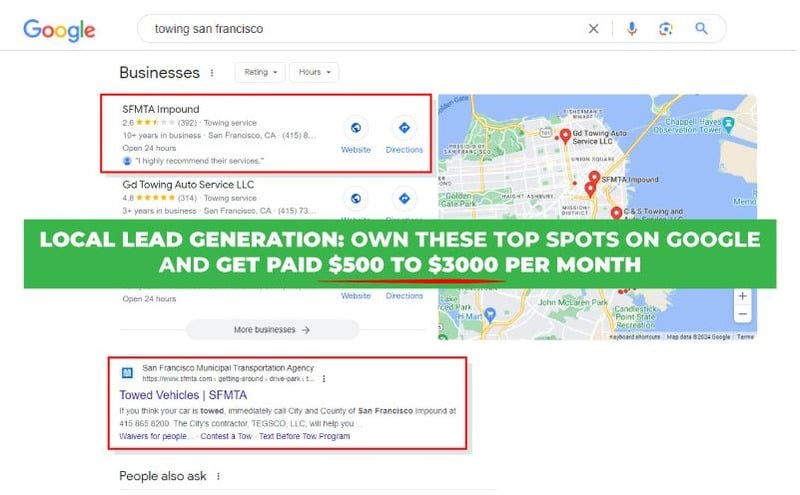
Local lead generation is my #1 business model because it makes me $52,000 per month, without me lifting a finger. This is because I already have 50+ ranked websites. One website alone, like my Chicago Premier Business Loan Solutions, 312 North Pulaski Road, Chicago, IL 60624, 773-985-2717, chicagobizloans.com, sells 6 leads to my client. My client, the business loan solution company, makes $40,000 from those leads. I ask for a 10% commission, so I get $4,000 per month.
If you want to learn the skills for this business model, check out my local lead generation training program. I teach you how to create a website, rank it quickly, and sell leads to actual businesses. I have already trained over 7,4000 students. You can also work for one of my roofing clients for a commission (1% to 5%).

Follow Me
Ippei Kanehara
Founder/CEO
$52K per month providing lead generation services to small businesses
Ippei.com is for digital hustlers, industry leaders and online business owners.
His #1 online business recommendation in 2024, is to build your own lead generation business.